
Business
Mastering Essential Communication and Research Skills for Modern Business

Transitioning from a university environment to a high-stakes corporate setting is one of the most significant shifts a student will ever face. While academic life focuses on the acquisition of knowledge, the business world demands the application of that knowledge through precise communication and rigorous research. For undergraduate students, the bridge between these two worlds is built on a foundation of “transferable skills”—abilities that are nurtured in the lecture hall but perfected in the office. Success in the modern economy is less about what you know and more about how you synthesize and present that information to stakeholders who have very little time to spare.
Many students find that the jump from writing for a professor to writing for a CEO is steeper than expected. Professional reports require a level of structural integrity and data-backed authority that takes years to master. To bridge this gap, many proactive learners utilize a custom assignment writing service to analyze high-quality models of technical writing. By observing how professional writers structure complex arguments and cite diverse sources, students can accelerate their own understanding of professional documentation. This form of “learning by example” is a common strategy for those aiming to meet the exacting standards of global business communication.
The Evolution of Business Research
In the past, business research meant looking at annual reports and market surveys. Today, it involves navigating a sea of “Big Data” and identifying actionable insights. For a student, this means moving beyond a simple Google search. You must learn to use academic databases, trade journals, and financial repositories to back every claim you make.
| Research Phase | Academic Focus | Business Application |
| Data Collection | Primary/Secondary Sources | Market Analysis & Consumer Trends |
| Synthesis | Building a Theoretical Argument | Identifying Competitive Advantages |
| Verification | Peer Review | Risk Assessment & ROI Projections |
| Presentation | Thesis Defense | Executive Summary & Pitch Decks |
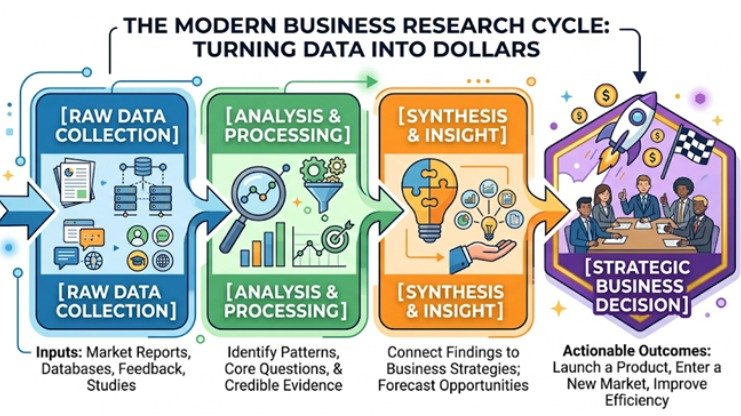 In a corporate boardroom, “I think” carries no weight. “The data suggests” is the phrase that wins budgets. Undergraduate students who master the art of objective research early on find themselves promoted faster because they provide the one thing every manager craves: certainty in an uncertain market.
Why Writing Clarity is the New Corporate Currency
We live in an era of information overload. A manager might receive 200 emails a day. If your communication is buried in “fluff” or academic jargon, it will be ignored. The “Global Tone” in business writing favors the active voice, short sentences, and a “bottom-line up front” (BLUF) approach.
To write like a professional, you must treat your reader’s time as a precious resource. This means:
- Front-loading Information: Put your conclusion in the first paragraph.
- Using Signposts: Headings and bullet points are your best friends.
- Eliminating Ambiguity: Instead of saying “sales grew a lot,” say “sales increased by 15%.”
The Power of Spontaneous Communication
While written reports provide the evidence, verbal communication provides the influence. In business, you won’t always have a week to prepare a PowerPoint deck. Often, the most important decisions are made during a hallway conversation, a sudden Q&A session after a pitch, or a networking lunch. This is where the ability to think on your feet becomes a superpower.
Mastering the art of an extemporaneous speech allows you to remain calm and structured even when caught off guard. At MyAssignmentHelp, experts often emphasize that communication is a holistic skill; it involves organizing your thoughts into a logical sequence—Introduction, Body, Conclusion—within seconds. This specific type of “prepared spontaneity” is what separates entry-level employees from emerging leaders. When you can speak clearly without relying on a script, you project an image of authority and deep subject-matter expertise that is highly valued in global markets.
Navigating the Digital Collaborative Space
Modern business is rarely a solo endeavor. Communication now happens across Slack, Zoom, and shared project management tools. For the undergraduate, this means “Research and Communication” also includes “Digital Literacy.” You must know how to tailor your tone for different platforms. A message on a team chat should be informal yet professional, while a formal proposal to a client remains rigorous.
Furthermore, global business means communicating across cultures. A “Global Tone” involves avoiding idioms or slang that might not translate well in a branch office in Singapore or London. It requires a level of empathy—understanding that your “clear” might be someone else’s “confusing.”
Analytical Thinking: The Goal of All Research
Ultimately, the reason universities place such a high premium on research papers is to develop your analytical muscles. In business, this is called “Critical Thinking.” It is the ability to look at a set of facts and see the patterns that others miss. Whether you are analyzing a chemistry lab result or a quarterly profit-and-loss statement, the process remains the same:
- Observation: What is happening?
- Analysis: Why is it happening?
- Inference: What will happen next?
- Solution: How do we fix or improve it?
Building Your Professional Portfolio
Students should begin treating their assignments not just as hurdles to pass a class, but as entries in a professional portfolio. If you write a research paper on “Sustainable Supply Chains,” that is a document you can show a future employer. It demonstrates your ability to handle complex data and communicate it effectively.
As you move through your undergraduate years, focus on the “why” behind the “what.” Why did that specific argument work? Why did that presentation fail to engage the audience? By becoming a student of communication itself, you prepare yourself for a world where your voice—written or spoken—is your most powerful asset.
Frequently Asked Questions (FAQ)
1. What is the difference between academic and business writing?
Ans: Academic writing is often exploratory and detailed, focusing on proving a theory. Business writing is transactional and concise, focusing on driving action or making a decision.
2. Why is “extemporaneous speaking” better than memorizing a speech?
Ans: Memorization makes you sound robotic and leaves you vulnerable if you forget a single word. Extemporaneous speaking uses a structured outline, allowing you to stay flexible and engage more naturally with your audience.
3. How can I improve my research skills for a corporate job?
Ans: Focus on finding diverse data sources. Don’t just look for “the answer”; look for conflicting viewpoints and data sets. Learning how to use tools like Excel or Tableau to visualize your research is also a major plus.
4. How do “human-centric” articles help in SEO ranking?
Ans: Google’s current algorithms prioritize “Helpful Content.” Articles that are easy to read, well-structured with headings, and provide genuine value to a specific audience (like students) tend to rank higher than those stuffed with keywords.
5. Is it okay to use professional services to help with my studies?
Ans: Using a service to gain a better understanding of how a topic should be tackled is a form of supplemental learning. It helps students identify the quality of work required at a professional level, provided they use the material as a guide for their own development.
6. Does the “Global Tone” mean I have to be formal all the time?
Ans: Not necessarily. It means being clear and inclusive. A global tone avoids local slang and ensures that the core message is understandable to someone regardless of their primary language or location.
About The Author
I am Lucy Wilson, a dedicated academic strategist and professional consultant at MyAssignmentHelp. With over a decade of experience in educational development, I specialize in helping undergraduate students bridge the gap between their academic requirements and the high standards of the global corporate world.

Mastering Essential Communication and Research Skills for Modern Business

Top 5 Test Automation Tools: 2026 Comparison

Reclaiming Your Life: The Comprehensive Guide to Choosing a Rehab Center for Alcoholics

How Franchisors Support Pet Store Franchise Owners

How TMS Treatment in LA Helps Patients with Depression

Unlocking Efficiency: The Ultimate Guide to AI Engineering Workflow Automation

Navigating Recovery Without Pausing Life: The Complete Guide to Outpatient Treatment

Why Smarter Snack Choices Are Becoming a Priority for Parents

Personalized Treatment Plans for Substance Use Disorders: A Path to Effective Recovery
