
Business
How Schools Use Animated Videos For Distance Learning

Published
4 months agoon
By
Abdus Subhan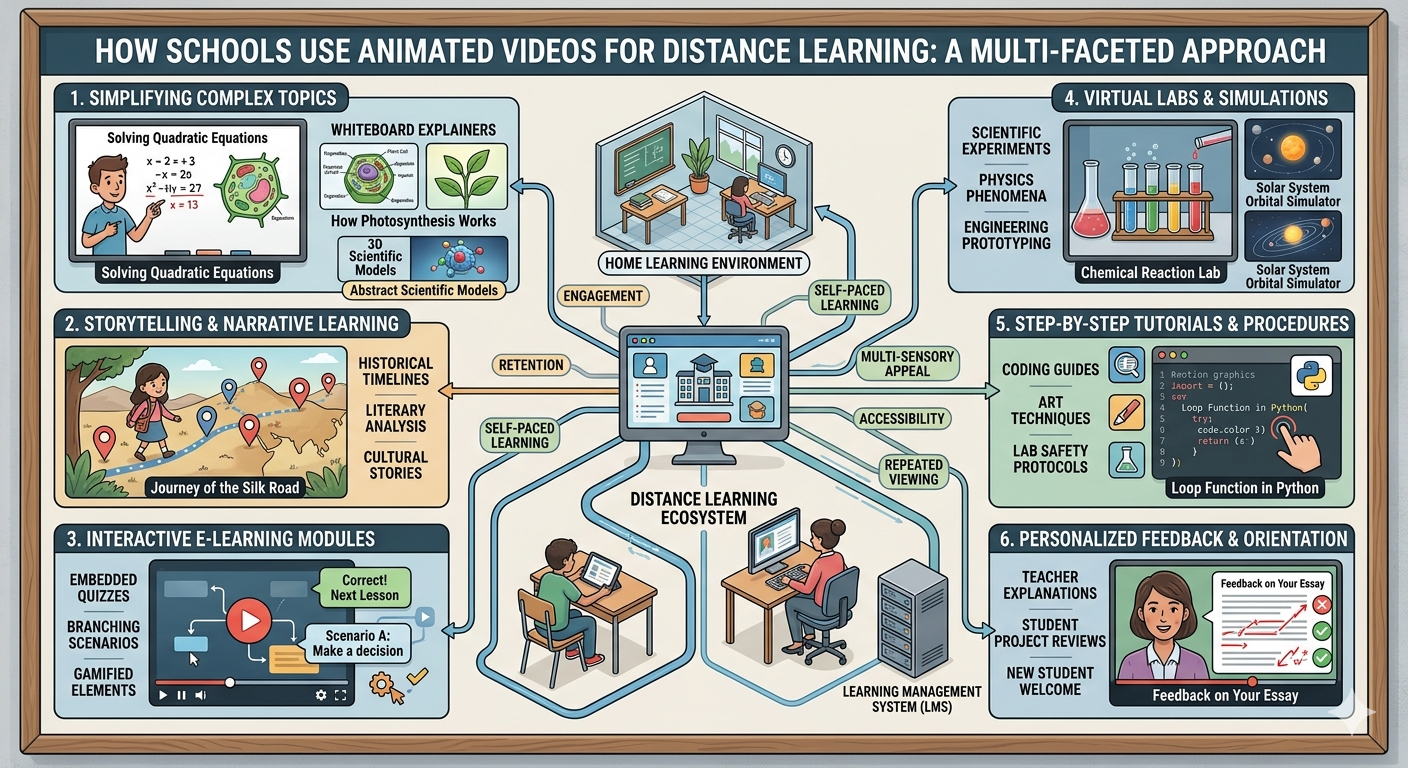
When classrooms went remote, teachers quickly discovered something uncomfortable: static slides on a screen hold almost no one’s attention for long. Students drift. Concepts don’t land. The issue isn’t the student, it’s the format.
Animated video quietly became one of the most effective solutions. It’s not just a trial anymore, but a meaningful change in how remote instruction is structured. What started as a quick fix has become a considered pedagogical choice, with growing evidence to back it up.
Animation Is Now a Teaching Tool, Not a Bonus
Schools aren’t using animated videos as reward content anymore. They’re using them as primary delivery for topics where text and static visuals simply underperform.
Consider explaining cell division through written description alone. Or asking a Year 8 student to mentally model tectonic plate movement without ever seeing it in motion. It creates unnecessary cognitive load where there doesn’t need to be any. Animation removes that barrier, students see the concept, follow the movement, and the understanding follows.
A 2023 study from the Journal of Educational Technology found that students learning through animated video retained concepts at a rate 40% higher than those taught through static text-based content. That’s not a marginal edge, that’s enough to reshape curriculum planning.
Students taught through animated video retained concepts 40% more effectively than those using static text alone enough to change how curriculum gets built.
What’s Driving This Shift in Remote Schools
The push toward animation in distance learning isn’t driven by aesthetics. It’s practical.
Once learning went remote, the little things disappeared; the movement, the quick feedback, the sense of presence. Animation helps replace that by making ideas clear on their own, without needing live explanation.
Subjects like physics, biology, and history benefit most. A visual treatment of the water cycle in 90 seconds communicates what a textbook chapter sometimes takes multiple re-reads to achieve. The same applies to economic systems, engineering flows, and historical causation chains, visual movement makes abstract systems legible without extra explanation.
There’s also the engagement reality. Cisco’s Visual Networking Index consistently shows video content drives significantly higher engagement across all age groups. In a home environment where a student’s phone is two feet away and Netflix is one tab over, animation competes on familiar territory. It holds attention in ways that reading assignments simply don’t.
The Types of Animation Schools Are Actually Using
Not all animation serves the same instructional purpose. Schools are getting more deliberate and more selective about the formats they commission.
3D Animation for Complex, Spatial Subjects
Anatomy, geology, structural engineering, space science, any topic that requires three-dimensional thinking has found a genuine partner in 3D video animation services. When a student watches a rendered cardiac cycle or sees tectonic subduction play out in three dimensions, comprehension shifts from conceptual to visual memory. That kind of learning sticks longer than a diagram ever could.
Several US school districts are now licensing 3D animated content specifically for STEM curricula. Production quality is not optional here. Poorly executed 3D can introduce confusion rather than resolve it, which is why educators are increasingly specific about the source and level of instructional alignment in what they commission.
Explainer Videos and Visual Storytelling
For social studies, economics, and literary analysis, schools lean toward shorter explainer formats. These work partly because they mirror how students already consume content: brief, structured, purposeful. A five-minute animated breakdown of the causes of the First World War, sequenced thoughtfully, can do more instructional work than an hour of passive note-taking.
The format also scales well. Once an explainer video is made, students can go through it at their own speed, stop to take notes, or use it again later at home. For teachers working across different time zones, that repeatability adds clear practical value.
Choosing the Right Animation Partner for Educational Content
Not every studio understands educational pacing, age-appropriate complexity, or how concepts need to sequence for learning rather than entertainment. That distinction matters far more than most institutions realise when they start shopping for content.
A motion graphics company experienced in working with educational clients approaches things differently. They understand how to balance instructional design, when to slow down, how to structure visuals to support learning, and how much information different age groups can take in. Schools sometimes focus too much on style, but a polished video that confuses the concept ends up missing the point. The right question to ask any animation partner isn’t ‘what does your work look like?’ – it’s ‘how do you approach instructional sequencing?’
The right question to ask any animation studio isn’t ‘what’s your style?’ ~ it’s ‘how do you sequence information for a learner, not just a viewer?’
What Early Results Are Telling Us
Adoption is expanding fast. HolonIQ estimates that global e-learning will surpass $400 billion by 2026, with animated video content leading much of that growth. This signals more than just a trend, it shows a shift in how education is delivered. Closer to everyday teaching, feedback from remote programmes consistently ranks animated explainers among the most useful resources. A clear animation can get a concept across in one go, saving time and avoiding repeated explanations.
In a remote environment where a teacher might be managing 30+ students across different learning paces and doing so asynchronously, that kind of front-loaded clarity has measurable value on both sides of the screen.
The Honest Limitation Worth Knowing
Animation isn’t a universal fix. It performs best when it’s integrated into a broader instructional plan, not deployed as a substitute for live teaching or curriculum structure. Schools achieving the best results are using animated content to supplement, not replace, the teaching relationship.
There’s also a cost reality. High-quality animation takes real skill and time. Institutions working with tight budgets sometimes end up with content that’s technically animated but educationally shallow. The investment level has to align with the instructional goal, otherwise you’ve paid for something that looks good in a parent presentation but doesn’t actually move learning outcomes.
Conclusion
Distance learning forces educators to rethink what ‘teaching’ looks like when the physical room disappears. Animated video turned out to be one of the most durable answers, not because it’s novel, but because it works with how the brain processes and retains visual information. For schools serious about remote education outcomes, this isn’t a trend to monitor. It’s infrastructure that was built deliberately.
You may like

Mastering Essential Communication and Research Skills for Modern Business

Top 5 Test Automation Tools: 2026 Comparison

Reclaiming Your Life: The Comprehensive Guide to Choosing a Rehab Center for Alcoholics

How Franchisors Support Pet Store Franchise Owners

How TMS Treatment in LA Helps Patients with Depression

Unlocking Efficiency: The Ultimate Guide to AI Engineering Workflow Automation

Navigating Recovery Without Pausing Life: The Complete Guide to Outpatient Treatment

Why Smarter Snack Choices Are Becoming a Priority for Parents

Personalized Treatment Plans for Substance Use Disorders: A Path to Effective Recovery
